*A kitchen scale that weighs food is absolutely necessary for baking, coffee, the keto diet, and exact meal planning since it transforms cooking into a science of precise measurement.
*Good kitchen food scales incorporate accurate weighing to grams, an easy-to-read or pull-out display screen, the ability to weigh in at least four units, and the functionality of taring.
*A stainless steel weighing surface, USB charging options, AC adaptor option, and 11 to 22 lbs weighing capacity are features available even in budget-friendly food scales costing less than $30.
*Our reviews center around testing kitchen food scales according to how they perform during our routine kitchen activities—baking bread, making coffee, measuring weight loss foods, and assessing whether each scale maintains its accuracy.
Why a Kitchen Food Scale Belongs on Every Counter
In 2026, home cooks have found that a food scale is more than just useful for baking purposes. Some of its uses include creating consistent bread, managing portions, making accurate coffee brews, and preventing food wastage. Using a kitchen food scale ensures accurate measurements and minimizes food waste. Getting an appropriate kitchen food scale is crucial.
Weighing ingredients is better than using volume measurements, as it makes baking or cooking easier. You could have a 30-gram difference in a cup of flour depending on its density, and in one test, a cup of flour weighed 110 to 150 grams depending on how it was scooped. Using weight measurements for your dry ingredients, such as flour, will help you avoid making a dense, heavy dish.
A kitchen scale is useful for baking ingredients such as butter, sugar, and flour, as well as liquids, making the process easier and faster. It is also helpful for portioning chicken for calorie counting, dialing in pour-over coffee doses, and splitting ground beef into equal burger patties. Weighing food gives exact gram data needed for precise calorie, protein, and carbohydrate tracking. Using the exact amount called for in a recipe extends the life of expensive ingredients.
Even a basic digital food scale can measure in grams (g), kilograms (kg), ounces (oz), and pounds (lb). Some have additional capacities to measure in kilograms, pounds, ounces, grams, and even milliliters (ml) when measuring liquids like water and milk. In most cases, people cooking at home will require no more than a 5-kilogram (11-lb) capacity kitchen food scale, but scales with higher capacities up to 10 kg (22 lb) may be required.
In short, a kitchen food scale transforms cooking into an exact science and improves the efficiency of a kitchen routine.
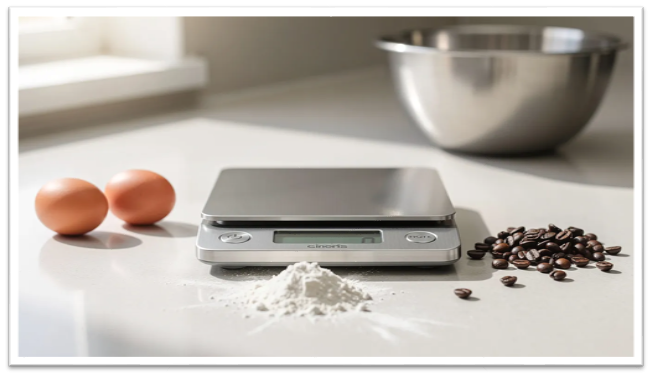
Types of Kitchen Scales and Which One You Need
“Kitchen scale” and “food scale” are umbrella terms. The right model depends on whether you bake, prep meals, brew coffee, or want one accurate scale for everything.
A flat scale is the best all-purpose choice. These flat digital food scales usually have a capacity of 11 lb or 22 lb, a compact body, and a smooth weighing platform. A stainless steel flat platform is easy to store and clean, but a basic kitchen scale may be less ideal for very small quantities, since general-use models are not very reliable below 10 g.
Bowl-style digital kitchen scales are useful for liquid batters, salad greens, berries, and loose ingredients. A large bowl keeps ingredients from rolling away and makes measuring easier, but its bulkier design takes up more counter space. An etekcity scale with a bowl is a popular example of this category, while Amazon Basics models are more often simple flat designs.
Grams and coffee scales are meant to measure smaller weights. A pocket scale will do much better than most kitchen scales when measuring extremely small weights less than 10 grams. Kitchen scales that work well for measuring coffee typically feature fast measurement speeds and timers, but unlike food scales, they generally have lower capacities and are costlier.
Mechanical scales represent the vintage type of scale without batteries. No batteries or ac adapters are required to operate these, but they may not be as precise and easy-to-use as the digital type. Home mechanical scales can measure 6 to 12 pounds, with an ideal weight of 11 pounds, which should suit most home chefs, while larger 22-pound models are suitable for heavier weights. If baking is done regularly and coffee is weighed sometimes, then an ideal kitchen scale would be a flat digital scale.
Key Features to Look For in the Best Kitchen Scales
Specs alone won’t give you the whole picture when it comes to weighing scales. Capacity, accuracy, measurements, and features are essential, but buttons, display clarity, cleaning capabilities, and performance during use in the middle of a recipe also matter. In most cases, home cooks will want a capacity of no less than 5 kilograms/11 pounds. Those who create stock or can recipes will find a 10-kilogram/22-pound model useful. For baking recipes, select a digital scale with 1-gram or 0.05-ounce increments. Scales with 0.1-gram increments are useful for measuring spices and leaveners; for all other cooking needs, one gram is enough. An excellent food scale is always very accurate, easy to read, and has a large flat surface plate to determine the precision baseline you need for baking and spice measuring.
It is recommended that most households have a capacity of at least 5 kg/11 lb. For those who prepare stock, canning recipes, and even large meals for family gatherings, the 10 kg/22 lb range is recommended. When preparing for baking purposes, a digital scale with 1-gram and even 0.05-ounce measurements is highly recommended. It would also be best to have one with 0.1-gram measurements for spices and leavening agents; however, regular 1-gram measurements will do fine for your everyday cooking needs. Ideal scales will always maintain 1-gram accuracy, be easy to read, and even come with a wide, flat surface so large bowls or pans stay stable without tipping and do not block the display, even though most scales still make that harder than it should be.
Response time is yet another practical aspect to consider. The delay in the digital display of your kitchen scales makes it difficult for you to pour any substance to the required weight, as your response would be delayed.
The tare function should be user-friendly, with a clear tare button that resets the display to zero after you place a bowl or container on the platform. Place a bowl on the platform, tare the scale, add 300 grams of flour, then tare the scale again and put 80 grams of sugar into the same bowl. The taring process should be quick; otherwise, you will get tired while preparing your favorite dish.
There should be at least four unit types, including grams, kilograms, ounces, and pounds. Speedy conversion from metric to imperial is necessary at this level, as some of the scales use ml units and even offer a liquid option in fluid ounces. It will be very helpful when cooking or making bakes, especially when there is a difference in density, but sometimes it may not help in calculating the volume of substances like flour, peanut butter, or chopped ingredients.
Convenience features are worth paying for if you cook often. A large, backlit LCD or digital screen is easier to read even when a bowl sits on the platform, and a backlight helps on a dim countertop. A pull-out display lets you read the weight under a large bowl or pan. Scales with long auto-shutoff windows are preferable so users do not lose their measurement if they need to step away briefly. Scales with long auto-shutoff windows are preferable so you don’t lose your measurement if you need to step away briefly.
Materials, Design, and Durability
In the kitchen, scales will sit amidst raw meat, spilled flour, moisture, coffee grounds, and sticky. Therefore, the material used to create a scale becomes an important factor.
It is advisable to choose a kitchen scale with a tempered glass or stainless steel surface, as these are the easiest to clean. The surfaces are easy to wipe since they resist flour and other spills, while plastic can stain and absorb odors over time. It is highly likely that stainless steel will provide durability and resist odor, discoloration, and staining. Glass appears elegant but scratches easily.
Plastic bodies are cheap and lightweight; however, they can feel fragile after some time. The rounded or slightly beveled area would prevent crumb accumulation along the joint line, and sealed controls with smooth surfaces are easier to wipe clean after spills. Button seals would prevent the electronics from becoming contaminated by flour and water.
Footprint matters in a small kitchen. A compact model can fit in a drawer or a 12-inch cabinet, whereas a bowl scale requires more space. Non-slip feet help keep the digital kitchen scale stable on stone, wood, or laminate counters.
Should you plan to retain the food scale on your kitchen countertop until 2026, it is advisable to choose a scale made of stainless steel or another metal that will not wear out quickly.
Digital Power Options: Batteries, USB, and AC Adapter
Most kitchen scales today are digital, and there is variation in their power source, which affects factors such as ease of use, replacement, and environmental impact.
Scales that run on batteries are battery powered and use either two AAA batteries or a CR2032 battery, although most kitchen scales use two AAA or AA batteries, which are readily available to replace. AAA-type scales tend to be thicker and easier to maintain. While CR2032 batteries are thinner, they may be difficult to replace if they fail during cooking.
USB-rechargeable food scales are becoming more common. USB-C models are especially convenient because you can top them up between baking sessions or before a long coffee routine. They also reduce disposable battery waste.
Some scales offer an AC adapter as an upgrade. This will be very useful for the serious baker who keeps their digital kitchen scale running throughout the weekend while working on a baking project, such as making bread or canning. The scale switches off automatically after five minutes of inactivity.
How To Test and Choose the Best Kitchen Scales
It is important to test the item rather than rely solely on its marketing. What we need is an accurate, clear, clean, durable one that will work in regular kitchen conditions, and our recommendations are based on tested kitchen scales in real-life scenarios.
Accuracy testing involves using calibration weights ranging from 1 g to 2 kg, as well as actual ingredients, such as a 1 kg bag of sugar. The difference is recorded in grams and ounces. The scales return to zero after taring, and readings are compared across the range to confirm they stay accurate as the weight increases. It is important to perform calibration tests periodically to maintain our accuracy on the same flat, level surfaces using calibration weights. When calibration weights are unavailable, common reference items such as coins can also help check accuracy.
These tests simulate actual actions: dividing the containers needed for the whole week’s food prep, weighing the wet sourdough culture in the jar, and testing whether the auto-shutoff timer runs long enough. A large stainless steel mixing bowl is placed on top of the scale to check visibility.
Tests consist of constant scrubbing with a wet cloth, water splashing near the button, and exerting pressure by placing pans and packed items. Our company cannot tolerate such products, which might appear to be good-looking but end up becoming useless when pressure is exerted through their usage, and packed products on it. Designs that may look elegant but prove weak under pressure are not appreciated.
Using a Kitchen Scale for Baking, Meal Prep, and Coffee
Digital kitchen scales can measure all ingredients and ensure uniformity in recipes across seasons and at different altitudes or humidity levels. This type of measuring equipment is especially useful when making recipes that require precise measurements.
When you bake, convert your cookie recipe from cups to grams for the first time and store the converted recipe in your recipe bank or app. Rather than using the “2 cups of flour” measurement, use the total grams of flour the recipe requires and weigh the rest of the ingredients, like butter and chocolate chips, in the bowl itself.
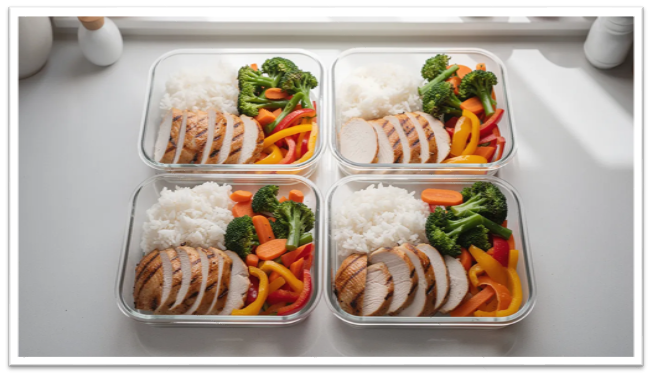
For meal prepping, it is advised that you take 150 g cooked chicken breast, 100 g cooked brown rice, and 75 g roasted veggies per meal container. Using a food scale lets you measure your portions accurately, which can help with meal prepping or managing your diet. For example, if you are working with a calorie tracker or a bot.
If you’re making espresso, the rule of thumb is to take 18 grams of ground beans per espresso cup. Or if you’re brewing via the pour-over method, consider a ratio of 1:16: 25 grams of coffee with 400 grams of water. With an accuracy of 0.1 grams, your coffee scale will help you adjust the grind and brew.
Care, Cleaning, and Long-Term Maintenance
Proper care and handling ensure the kitchen digital scale is precise and hygienic when used with food. The component used to measure an object’s load, called a load cell, is very sensitive.
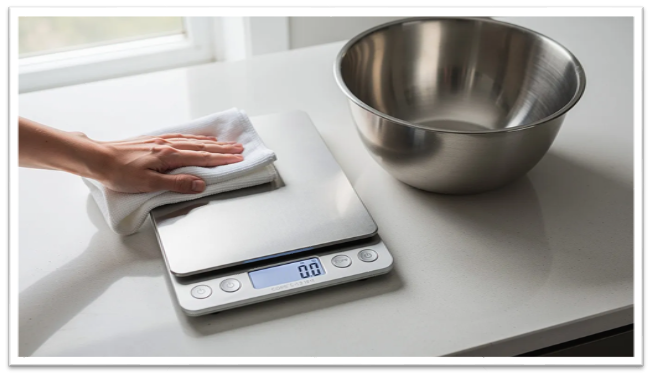
The kitchen scale must not be submerged in water or cleaned with strong cleaners, but it can be wiped with a moistened cloth. A scale with sealed controls and a smooth platform is also easier to wipe clean. In cases where there may be flour, it is best to clean the surface first by wiping it with a dry towel to avoid floury paste from sticking to the buttons and the surface.
Some kitchen scales have removable weighing trays that can be washed and sanitized separately from the scale itself, making cleaning easier. A scale with a removable weighing tray is a plus for cleaning, especially if you weigh raw meat, sticky dough, or oily ingredients.
Do not drop any cast iron pots onto the platform or overload it beyond the mentioned 11 lb or 22 lb capacity. Excessive weight damages the load cell, and readings will go out of sync. It should be stored horizontally or vertically inside a cabinet, but no weight must be placed on the measuring platform.
In case of any fluctuation in readings, first check the battery/power supply by replacing or recharging them. Later on, test using a fixed load such as a 100g standard weight, and check the owner’s manual for model-specific recalibration steps. In the end, proper care ensures that the weighing scale will not require replacement for many years.
Kitchen Food Scale FAQs
This list covers problems with present-day digital kitchen scales from 2020 to 2026 and helps readers choose the best kitchen scale for current features and use cases, including LCD screens, multiple units of measurement, and the tare function. Consult the user guide for your manufacturer’s product for the steps specific to your product.
Can I use one kitchen scale for both food and small packages?
Yes. Kitchen scales are useful for various purposes, including baking, meal preparation, and even weighing small packages for shipping. Most 11–22 lb digital kitchen scales with gram and ounce units can weigh small parcels as long as the box fits and does not block the display. Keep the surface clean between food and package weighing; if you ship items for business, a dedicated postal scale may be better.
How accurate does my kitchen scale need to be for baking?
For normal baking at home, one gram (0.05 ounces) is usually the minimum practical increment and should suffice. Normal kitchen scales can handle baking with an accuracy of 1 gram or 0.05–0.1 ounce, though you may need something more precise for smaller amounts, since more weight on the platform generally improves consistency and tiny amounts are harder for a standard scale to register to the same point of precision. Minor inaccuracies of 1–2 grams will most likely not harm your loaves, cookies, or muffins.
Is a pull-out display worth paying extra for?
If you are using larger bowls, sheet pans, or Dutch ovens, yes. A sliding display pulls out the screen to reveal the numbers, which would otherwise be blocked. In smaller kitchens, this design can work within the thin profile, and the benefits usually make up for the slightly higher cost.
What units should my kitchen scale have at a minimum?
At least, select grams and ounces. The other options include pounds and kilograms, which can be used when dealing with large quantities of materials, meat, and other large dishes. Units such as grams, kilograms, ounces, and pounds, among others, can come preinstalled in your measuring tape of choice by 2026.
How long should a good digital kitchen scale last?
A high-quality stainless steel digital food scale will last 5 to 10 years if used normally in the home. The lifespan depends on regular maintenance, including keeping the weighing platform clean and dry, preventing water from entering the buttons, and maintaining the battery until the end of its life cycle. Some Bluetooth scales can sync with apps to track nutritional data, which is helpful for strict dietary tracking. Inconsistencies in measurements can be addressed by first changing the battery, recalibrating, and cleaning.
My recommendation: an affordable pick like the escali primo is often enough for everyday home use, and a seasoned food writer would still value its straightforward accuracy.
 gwagner007-txivo